 Prepo
Prepo valuation translates PreStocks token prices into implied company value
Prepo valuation expresses a company's implied value through the dollar price of its PreStocks token. Under the published pricing convention, a $100 token price represents a $100 billion implied company valuation. The figure describes the company that the token references, while the holder owns a token that provides economic exposure without shareholder rights.
Updated on
The project announced its Solana launch under the PreStocks name on August 7, 2025. Reading that product's valuation requires keeping the token quote, the referenced company's value and the value of a holding in separate units.
The quote uses a billion-dollar scale
The dollar price of an individual PreStocks token encodes a company valuation expressed in billions of dollars. A $100 token quote represents a $100 billion implied company valuation under the launch pricing convention. The currency remains dollars, but the quoted token amount and the company-value amount sit on different scales.
The relationship is
implied company value in dollars = token price in dollars × 1,000,000,000
. Token supply is not an extra multiplier in that conversion. The convention expresses the referenced company's implied value; calculating the market capitalization of the token answers a different question.
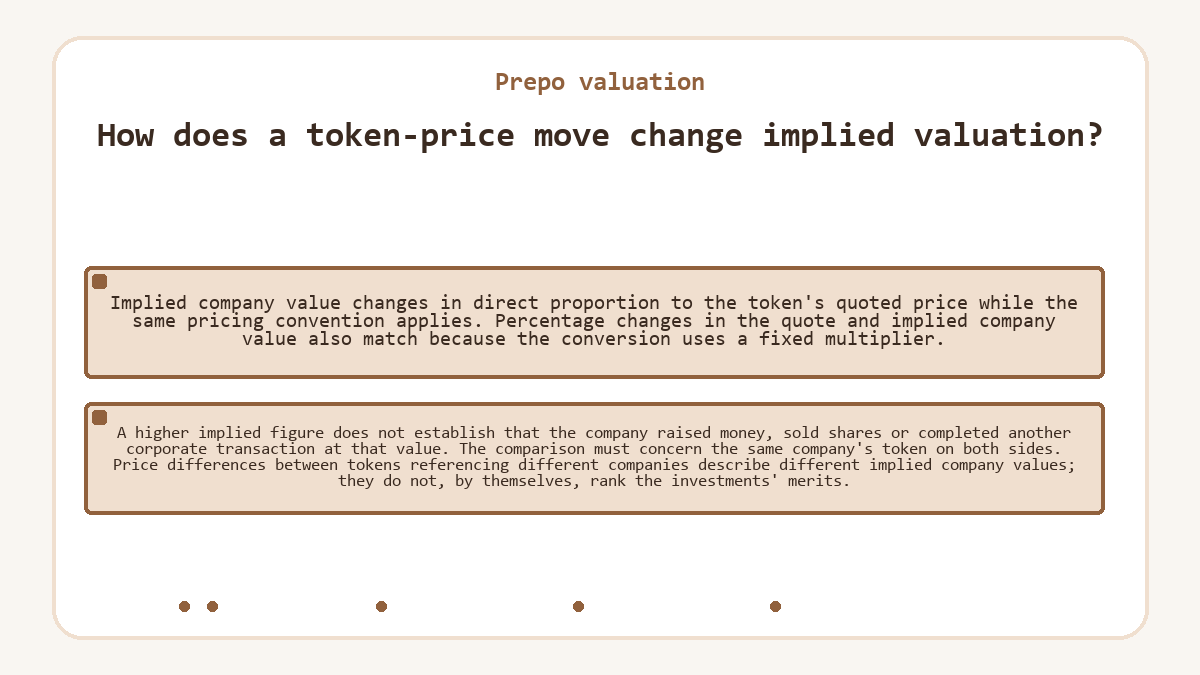
How does a token-price move change implied valuation?
Implied company value changes in direct proportion to the token's quoted price while the same pricing convention applies.
Percentage changes in the quote and implied company value also match because the conversion uses a fixed multiplier. A higher implied figure does not establish that the company raised money, sold shares or completed another corporate transaction at that value.
The comparison must concern the same company's token on both sides. Price differences between tokens referencing different companies describe different implied company values; they do not, by themselves, rank the investments' merits.
Company value and holding value use different inputs
A holding's quoted value uses the number of tokens held multiplied by their per-token price. Company valuation uses the pricing scale attached to that price. Holding more tokens changes the size of the position, while the meaning of the per-token quote stays the same. Multiplying the implied company valuation by the token count would confuse a company-wide figure with a position value. The quoted value of a holding also differs from the amount that can actually be received from a sale when liquidity or transaction costs affect execution.
Token quotes and mark valuations need matching units
The product listing displays Token Price, Implied Val, Mark Val and Mark Price Premium % as separate fields. The first two connect through the valuation scale. A conversion from token price therefore gives token-implied company value. It does not explain how a separate mark valuation was established.
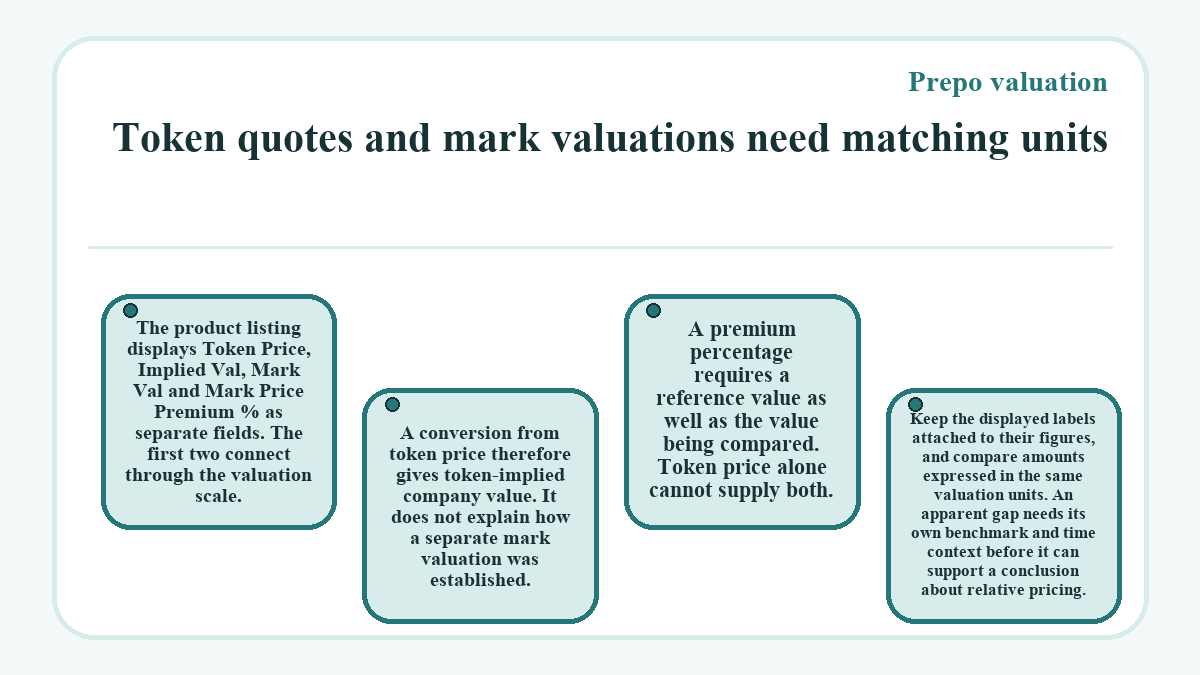
A premium percentage requires a reference value as well as the value being compared. Token price alone cannot supply both. Keep the displayed labels attached to their figures, and compare amounts expressed in the same valuation units. An apparent gap needs its own benchmark and time context before it can support a conclusion about relative pricing.
Does SPV backing guarantee a sale at the implied valuation?
SPV backing does not guarantee a sale at a price corresponding to the displayed implied company valuation. PreStocks describes its tokens as backed by exposure through a special purpose vehicle, or SPV. That backing concerns the economic exposure behind the token. A holder still needs secondary-market liquidity to sell, and PreStocks states that this liquidity is not guaranteed.
For eligible participants, trading access runs around the clock. Those hours do not commit anyone to buy a holding at its quoted value. The company-scale number does not reveal the depth of demand for the token. Holders can lose their entire investment despite the stated backing.
Expiry changes the meaning of a pre-IPO quote
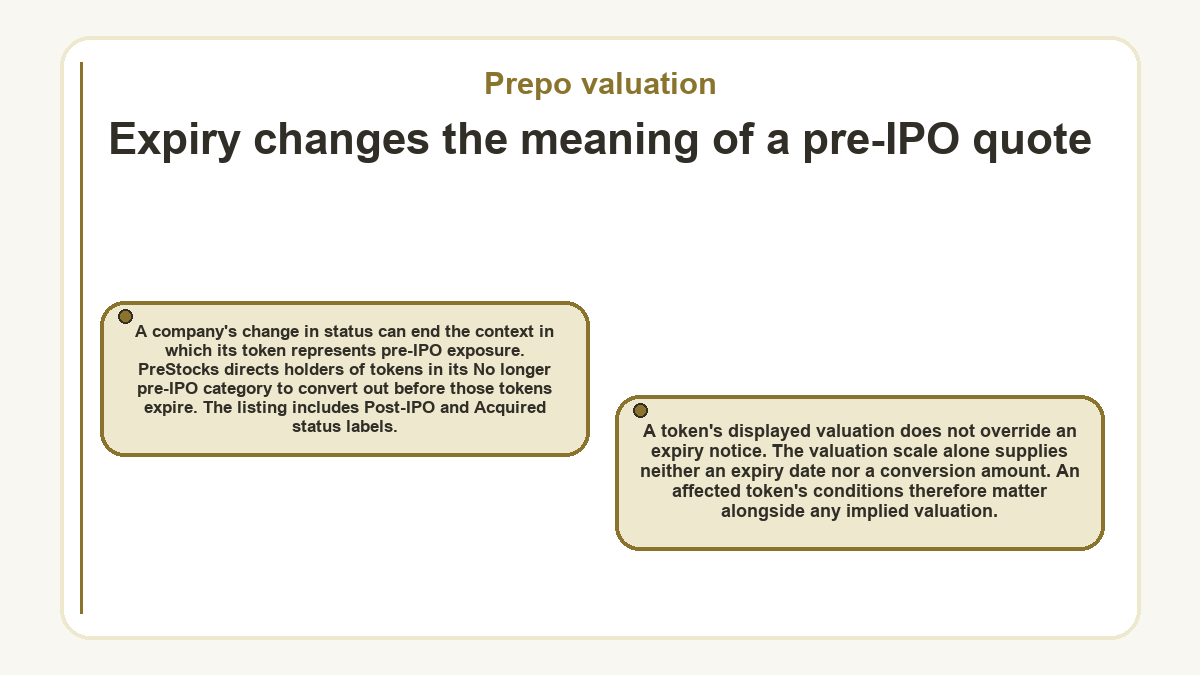
A company's change in status can end the context in which its token represents pre-IPO exposure. PreStocks directs holders of tokens in its No longer pre-IPO category to convert out before those tokens expire. The listing includes Post-IPO and Acquired status labels. A token's displayed valuation does not override an expiry notice. The valuation scale alone supplies neither an expiry date nor a conversion amount. An affected token's conditions therefore matter alongside any implied valuation.
Conditions for reading a displayed valuation
- Keep price-change comparisons on the same company's PreStocks token, with the same pricing convention.
- If its quoted price rises or falls, the implied company valuation moves proportionally in the same direction.
- If only token quantity changes, recalculate holding value without changing the company valuation implied by the quote.
- Compare Implied Val and Mark Val with their displayed labels and valuation units intact.
- If the token carries a No longer pre-IPO notice, include its conversion and expiry conditions in the interpretation.
Prepo valuation: quick answers
Is this the valuation of the PreStocks business itself?
The pricing convention applies to the company referenced by an individual PreStocks token. It does not price the PreStocks business. A quote must therefore stay attached to its particular company token; the same scale expresses a separate implied valuation for each referenced company.
Was $100 a fixed launch price for every company token?
The $100 figure illustrated the valuation scale in the August 7, 2025 launch announcement; it was not a fixed price assigned to every company token. It shows that a $100 token quote corresponds to a $100 billion implied company valuation, without establishing an actual trading price for any particular token.
What does a token-implied valuation reveal about company revenue?
A token-implied valuation expresses company value rather than revenue over an accounting period. The price conversion alone does not supply sales or earnings data. Revenue-based and earnings-based valuation multiples require those separate financial inputs, so neither multiple can be calculated from the token price alone.
Does a displayed valuation include the total cost of buying a token?
A displayed company valuation does not state the total amount payable for a token purchase. The purchase amount uses token quantity and execution price, with any applicable transaction charges considered separately.
Can seeing a PreStocks valuation quote establish eligibility to trade?
Seeing a valuation quote does not establish eligibility to buy the token. PreStocks excludes the United States, other prohibited jurisdictions, U.S. persons and other ineligible participants. A valuation is a pricing measure; it does not remove the restrictions that apply to access or participation.